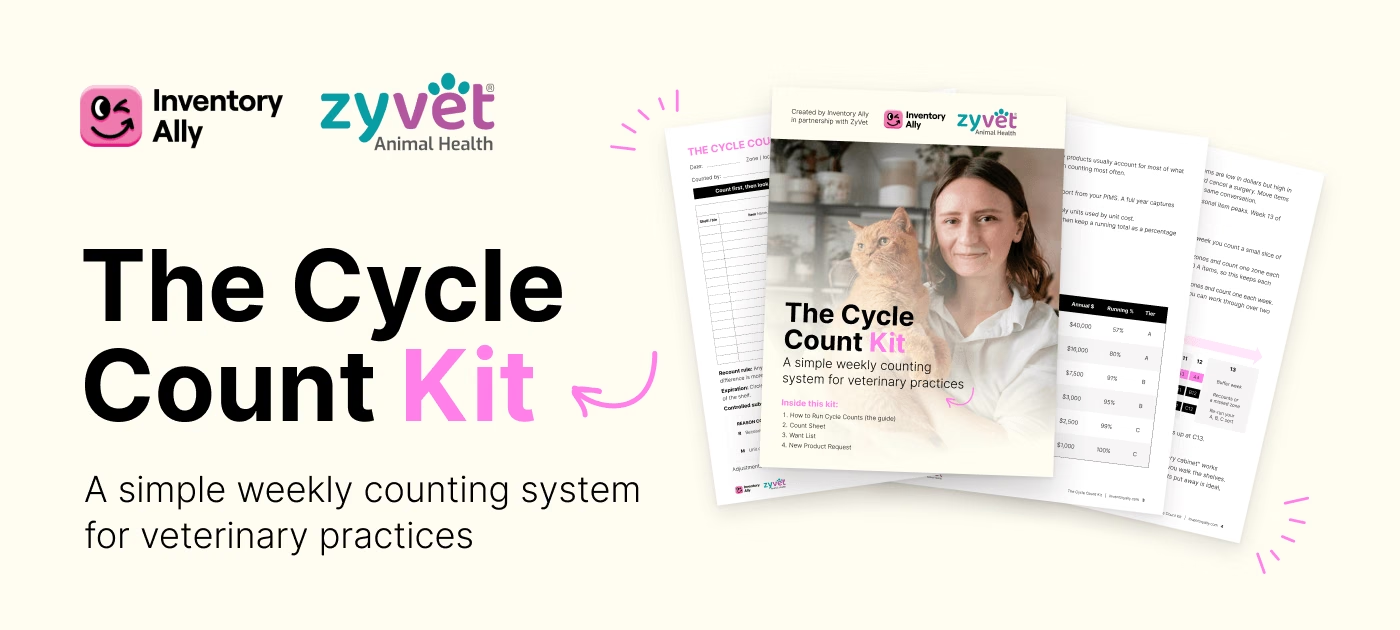
A cycle count is a small, scheduled count of part of your inventory. Instead of counting every shelf once a year, you count a small, set portion every week. Your highest-value items come around most often, and everything gets checked at least twice a year. It takes a short block of time each week, and the numbers in your PIMS stay close to what’s actually on your shelves all year.
Below, we walk through how to set up a veterinary cycle count system: how to sort your items, how often to count each group, how to run a count, and what to do when the numbers don’t match. Everything here is also in our free Cycle Count Kit, along with a printable count sheet, a want list, and a new product request form you can start using this week.
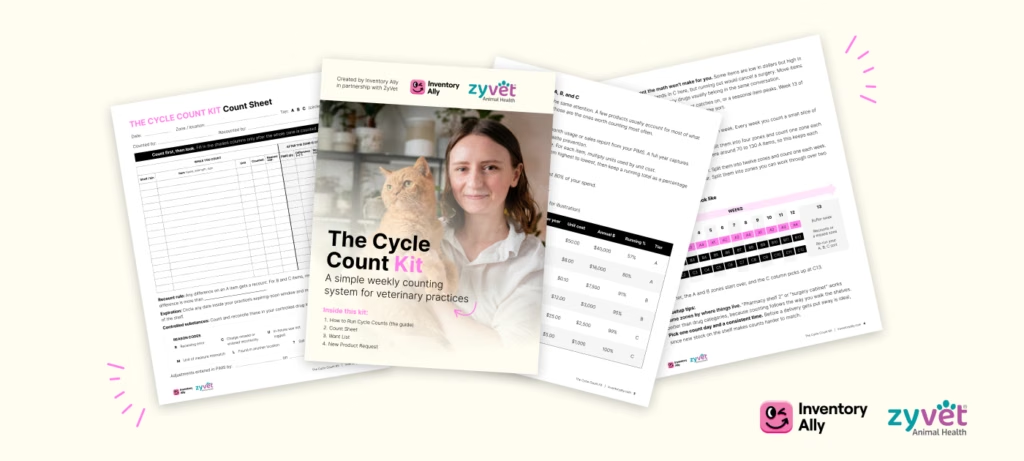
The Cycle Count Kit includes:
- How to Run Cycle Counts, a short guide with a worked ABC example, a sample 13-week schedule, and a plan for your first month
- The Count Sheet, with columns for unit of measure, expiration dates, and reason codes
- The Want List, for special orders, doctor requests, and backorder follow-ups
- The New Product Request, four forms per page, each with a check for products you already stock
Cycle counts vs. the annual inventory count
An annual count gives you an accurate picture of your inventory on one day. Cycle counting keeps that picture accurate the rest of the year, which pays off in a few ways.
Your reorder points fire on time. A reorder point can only flag an item when the quantity it’s checking against is right.
Differences are easier to trace. When an item was counted last month, a mismatch points to something recent.
Expiration dates get seen. Every count is a chance to spot short-dated stock and move it to the front.
Year-end gets lighter. Many practices still do a full count for their accountant. With cycle counts running all year, that count becomes a check rather than a correction.
How often to count: sorting veterinary inventory into A, B, and C
Not every item needs the same attention. In most practices, a small group of products accounts for most of what gets spent on inventory, and those are the items worth counting most often. The usual way to find them is ABC classification: rank your items by how much you spend on each over a year, then split them into three tiers.
| Tier | What’s usually in it | How often to count |
|---|---|---|
| A | Vaccines, preventives, your fastest-moving pharmacy items | Once a month, a quarter of them each week |
| B | Steady everyday medications and supplies | Once a quarter |
| C | Low-cost, slow-moving items | Twice a year |
Critical items can move up a tier even when they’re inexpensive. Suture might sort into C on cost alone, but running out would cancel a surgery. The kit walks through the full sort with a worked example, plus a sample 13-week schedule that shows how all three tiers fit into each week.
The exact schedule matters less than keeping it. Cycle counting only pays off when it’s consistent, so plan around your busiest, most short-staffed week. A small count that happens every week beats a bigger one that gets skipped.
How to count inventory in a vet clinic
Three habits make the biggest difference:
- Count in the unit your PIMS uses. If your system tracks tablets, count tablets, not bottles. Mismatched units of measure are one of the most common reasons counts drift.
- Count first, then look. Keep the expected quantity out of sight until the whole zone is done, so you count what’s really there.
- Check expiration dates as you go. A count is the easiest moment to rotate stock by first-expired, first-out.
The guide in the kit covers the full routine, from naming your count zones to picking the best time to count.
What to do when your count doesn’t match your PIMS
Differences are normal, especially in the first few rounds. Recount first, ideally with a second person. Then find the cause, adjust your PIMS, and note the reason. Over time, those reasons show you where your numbers drift, whether that’s missed charges, receiving errors, or supplies used in-house without being logged. The count sheet in the kit includes a reason code key, so tracking this takes one letter per line.
Where a want list fits
Reorder points and cycle counts cover your regular stock. A want list catches what they can’t see coming: special orders, doctor requests, and backorder follow-ups. New products get their own form in the kit, with one question to answer before anything joins the shelf: do we already stock something that does this?
A note on controlled substances
Controlled substances follow their own rules. Count and reconcile them against your log books as often as it takes to keep those logs accurate. Depending on the practice, that might be the end of every shift, the end of each day, or the end of each week. Cycle counts also don’t replace the DEA biennial inventory or any inventory your state requires.
Your free veterinary inventory count sheet and Cycle Count Kit
Everything above is ready to print and use. The Cycle Count Kit includes:
- How to Run Cycle Counts, a short guide with a worked ABC example, a sample 13-week schedule, and a plan for your first month
- The Count Sheet, with columns for unit of measure, expiration dates, and reason codes
- The Want List, for special orders, doctor requests, and backorder follow-ups
- The New Product Request, four forms per page, each with a check for products you already stock
When you’d like the schedule built for you
The kit runs well on paper, and plenty of practices keep it that way. If you’d rather hand off the sorting and scheduling, that’s what Inventory Ally does. It builds a weekly cycle count schedule from your order history, prioritizes items by value and sales volume, and recommends how much to restock after each count. Practices using Inventory Ally reduce their inventory on hand by 30 to 50%.
About ZyVet Animal Health
ZyVet Animal Health develops FDA-approved generic medications for companion animals. Based in Pennington, New Jersey, ZyVet brings the experience of its parent company, Zydus Lifesciences, and its 70 years in generic pharmaceuticals to U.S. veterinary practices. Practices using Inventory Ally can track and reorder ZyVet products right in the platform. Learn more at zyvetusa.com.
