
The cabinet’s empty mid-appointment. A box of vaccines expired last week and nobody noticed. The order that was supposed to arrive Tuesday is still sitting in someone’s email drafts. Inventory becomes a fire to put out rather than a system to run.
The tasks that prevent those fires are rarely the dramatic ones. They’re quiet, easy to postpone, and almost never assigned to anyone in particular, which is exactly why they get skipped. But they’re also where clinics lose money, time, and a surprising amount of stress.
Here are five of them. None require a total system overhaul to start thinking about. They just require thinking about them at all:
1. Decide who actually owns inventory
This is the one everything else depends on, so it goes first.
In a lot of clinics, inventory is technically “everyone’s job,” which in practice means it’s no one’s. The vet who notices the suture supply is low assumes someone will reorder it. The tech who unpacks the delivery doesn’t know what the reorder points are supposed to be. Counts happen when someone has a spare twenty minutes, which is to say almost never.
When a task is shared by everyone with no clear owner, it falls through the cracks by default. Not because anyone’s careless, but because nobody woke up that morning responsible for it.
You don’t need to hire a dedicated inventory manager, but you do need clarity. Who’s responsible for placing orders? Who checks in deliveries and confirms they match what was ordered? Who runs counts, and how often? Even a single named person who owns the overall process, with a couple of defined hand-offs, changes everything. It turns inventory from a thing that happens to you into a thing someone is actually steering.
If you take only one idea from this article, make it this one. The rest get a lot easier once somebody’s holding the wheel.
2. Set reorder points per item, and revisit them
“Order more when we’re getting low” feels like a system. It isn’t, really. “Low” means something completely different for a fast-moving consumable than it does for a specialty medication you dispense twice a year.
A proper reorder point accounts for how quickly you go through an item and how long it takes to restock. A product you use daily, from a supplier who takes a week to deliver, needs a much higher trigger than something you barely touch. Set them too low and you’re constantly scrambling or back-ordering. Set them too high across the board and you’ve got cash tied up in stock you don’t need yet.
The part that gets skipped is revisiting them. Your reorder points should reflect your clinic as it is now, not as it was two years ago. Caseloads shift, seasons change, a new vet joins and suddenly you’re using three times the dermatology stock you used to. Points that were dialed in last spring may be wrong today. A quick review every quarter or two keeps them honest.

3. Know your carrying costs
Here’s a number most clinics can’t say off the top of their head: how much money is sitting on your shelves right now?
Stock isn’t free just because you’ve already paid for it. Every unopened box represents cash you can’t use for anything else, plus the very real risk that some of it expires before you sell or use it. That’s your carrying cost, and overstock is one of the most common (and most invisible) ways a clinic ties up money without realizing it.
It’s easy to over-order. Ordering in bulk feels efficient, the rep offers a deal, nobody wants to be the person who let something run out. So shelves fill up, and a chunk of working capital goes to sleep in a back room.
You can start by simply knowing roughly what your on-hand inventory is worth and keeping an eye on the slow movers — the items that have been sitting there since you can’t remember when. Those are usually where the trapped cash and the expiry risk overlap. Awareness alone tends to make ordering more disciplined.
Read More: 5 Inventory Metrics Every Practice Manager Should Track
4. Manage expiration dates with FEFO
Most people, stocking a shelf, naturally put the new stuff behind the old stuff. That’s first-in-first-out, and it’s fine for a lot of things. But for a veterinary clinic, the date that matters isn’t when something arrived — it’s when it expires.
Those aren’t always the same. A shipment that came in last month might expire before one that’s been on your shelf since last quarter, depending on lot dates. So the better discipline is FEFO: first-expired-first-out. You use what expires soonest, regardless of when it showed up.
This matters everywhere, but especially for vaccines, biologicals, and controlled substances, where an expired product is a compliance and patient-safety problem. Expired controlled substances in particular come with their own disposal and documentation requirements you don’t want to discover the hard way.
Practically, FEFO means actually reading and organizing by expiration dates when you put stock away, rotating shorter-dated items to the front, and checking for upcoming expirations on a regular schedule rather than discovering them after the fact. It’s a small habit at the shelf that prevents a lot of write-offs.

5. Reconcile what you used against what you billed
Every time you use a product on a patient, two things should happen: it comes out of your inventory, and it goes onto the invoice. When those two don’t match up, you’ve got a problem in one of two directions. Either you used something and didn’t charge for it (lost revenue, plain and simple), or your records say you should have stock you don’t actually have (shrinkage, miscounts, or product walking off in ways nobody intended).
Missed charges are easy to underestimate. A few uncharged items a day doesn’t feel like much in the moment, but across a year it adds up to real money. And because it never shows up as a dramatic loss, it’s almost never noticed.
Reconciling usage against billing closes that gap. It tells you whether what’s leaving your shelves matches what’s showing up on invoices, and it surfaces both the revenue you’re missing and the stock that’s disappearing. You don’t have to audit every item every day, but even spot-checking your high-value or high-volume products periodically will tell you a lot.
The common thread
Notice what these five have in common: none of them are urgent, and nothing breaks today if you skip them. That’s precisely why they’re so easy to let slide, and why the clinics that do them consistently tend to run calmer, leaner, and more profitably than the ones constantly reacting.
The good news is you don’t have to overhaul everything at once. Pick one. Decide who owns inventory this month, or sit down and revisit your reorder points, or run a single reconciliation spot-check and see what it tells you. Each of these is a real win on its own, and they build on each other naturally. A clinic that’s nailing even two or three of these is already ahead of most.
A quick note from us at Inventory Ally
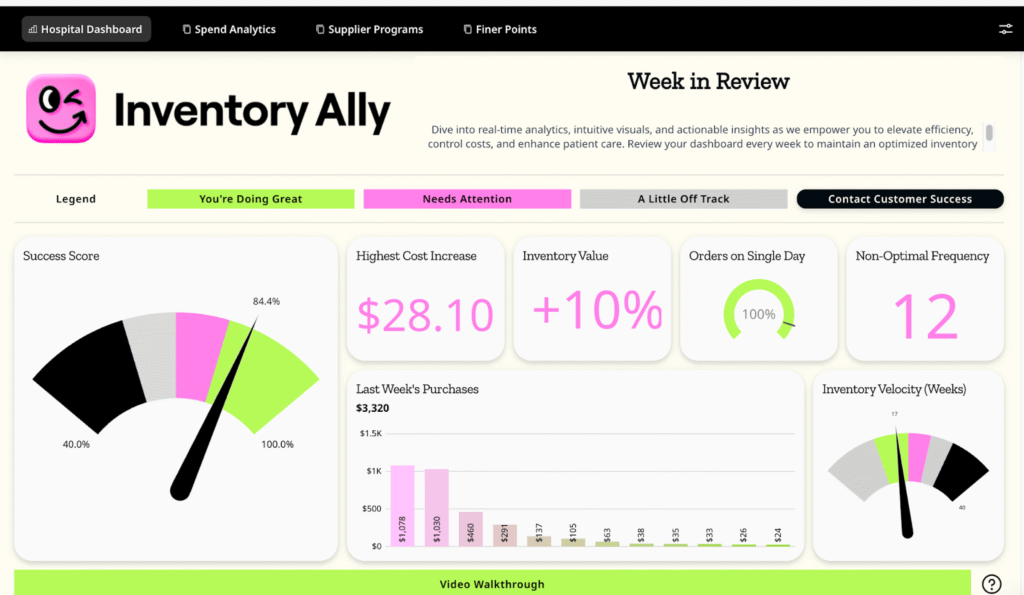
Everything above works whether or not you ever use software, but it’s also exactly the kind of work software is built to take off your plate. Inventory Ally handles per-item reorder points, tracks the value sitting on your shelves, flags expirations, and connects usage to billing so nothing slips through. If managing all this by hand is starting to feel like a second job, see how Inventory Ally can help. We’d be glad to show you around.