
Here’s the uncomfortable truth: your practice is probably losing at least 15-20 hours every single week. Not because your team isn’t working hard enough. They’re working harder than ever! The problem is that those hours are disappearing into invisible inefficiencies that feel like “just how things are done.”
A few extra minutes on a phone here. Ten minutes hunting down missing inventory there. Staff staying late to finish charts. It all compounds into something much bigger: burnout, bloated costs, and the nagging sense that you’re running in place.
The practices that are thriving right now aren’t necessarily the ones with the most experienced clinicians or the latest technology. They’re the ones that identified these hidden time drains and systematically eliminated them. This article walks through the five biggest culprits we see across veterinary practices, and more importantly, the practical fixes that work without requiring a complete operational overhaul.
Let’s dig in.
Time Waster #1: Manual Appointment Handling & Phone Overload

Why it drains your practice
Every time the phone rings, someone has to stop what they’re doing, answer questions, check availability, manually block out time in your PIMS, send a confirmation email, and then inevitably follow up when the client doesn’t respond.
Meanwhile, three other calls are going to voicemail. Those missed calls? They’re not just inconvenient, they’re unfilled appointments and lost revenue.
Then there’s the data entry part: information gets taken over the phone, written on a sticky note, transferred to an email, and finally entered into your practice management system. Each handoff is an opportunity for errors, and your team is essentially doing the same work three times.
The fix
Online scheduling with automated reminders is no longer a nice-to-have, it’s a necessity. When clients can book appointments themselves (especially outside business hours when most people are actually thinking about their pets), you capture appointments you would have otherwise missed. The system does the heavy lifting: checks availability, sends confirmation texts, and follows up with reminders automatically.
Text-based communication takes the pressure off your phone lines. Clients can text to reschedule, ask quick questions, or confirm appointments without tying up your staff. For many practices, this single change reduces incoming calls by 40-50%.
Smart scheduling rules prevent the chaos of double-bookings and inappropriate appointment types. Set parameters: for exam rooms, procedure times, doctor availability, and let the software enforce them. Your staff stops piecing together the schedule, and you stop running 45 minutes behind by 10 AM.
The goal is to reserve your team’s energy for the interactions that actually matter.
“Self service scheduling is not about replacing people, it’s about protecting them. Let clients book, confirm, and reschedule asynchronously, then keep the phone line for the situations that truly need a human.”
— Adam Wysocki, Founder of VetSoftwareHub.com
→ Read more: The Vet’s Guide to Essential Veterinary Software
Time Waster #2: Inefficient Client Intake & Paperwork Bottlenecks

Why it creates chaos
Picture your lobby at 11:15 AM on a Monday. Three clients are standing at the desk with clipboards, trying to fill out forms while wrangling anxious dogs. Your receptionist is squinting at barely legible handwriting, trying to decipher whether the emergency contact number starts with a 3 or an 8. Another staff member is typing the same information—owner name, pet name, vaccination history—into your PIMS for the third time this morning.
Meanwhile, appointments are backing up because intake is taking 8-10 minutes per client instead of the 5 minutes you’ve budgeted for. By 1 PM, you’re already running behind, and the rest of the day becomes a game of catch-up you’ll never win.
The real killer? When information is incomplete or illegible, your team has to hunt down clients mid-appointment to clarify details. “Wait, did you say he’s on thyroid medication? What dose?” It disrupts workflow, frustrates clients, and increases the risk of medical errors.
The fix
Digital intake forms synced to your PIMS eliminate the double-entry trap. Clients fill out forms on their phones or a tablet in your lobby, and the information flows directly into your system—no re-typing, no transcription errors, no sticky notes.
Mobile pre-registration takes this even further. Send the forms the day before the appointment. Most clients will complete them from home, which means they walk in ready to go. Check-in drops from 10 minutes to 90 seconds: confirm identity, verify the pet, done. Your front desk can actually greet clients instead of drowning in paperwork.
Automated data capture handles the tedious stuff—pulling previous visit information, flagging incomplete fields, and ensuring consistency across records. If a client mentions their dog is on ‘Apoquel,’ the system recognizes the medication name and auto-fills the correct spelling and typical dosing information: no more ‘Apoquell’ or creative variations. Small details, massive time savings.
The best part? Your team stops chasing missing information and starts focusing on the medicine.
“Pre-registration is one of the highest ROI automations in a clinic because it compresses check-in time and reduces errors. Small minutes saved per appointment become real hours saved per week.”
— Adam Wysocki, Founder of VetSoftwareHub.com
Time Waster #3: Inventory Chaos & Manual Stock Management

Why it’s draining your resources
If you’ve ever had a technician stop mid-procedure to run to the supply room, only to discover you’re out of the exact item they need, you know this pain intimately. Inventory chaos doesn’t just waste time, it derails your entire day.
Most practices are managing inventory the same way they did twenty years ago: manual counts with clipboards, gut-feel reordering, and constant firefighting when something runs out. Staff spend several hours each week physically counting shelves, often finding expired products tucked in the back or discovering $3,000 worth of vaccines that nobody remembered ordering.
Manual inventory management creates a cascade of expensive problems. Practices discover thousands of dollars worth of expired products sitting on shelves. Cost of goods sold creeps up to 25-30%, meaning nearly half of every dollar coming in immediately goes back out to cover inventory mistakes.
The hidden costs multiply fast: overstock ties up cash flow you need elsewhere, expired products become pure loss, emergency orders eat into margins with rush fees, and staff spend hours each week doing manual counts that never quite catch everything. Poor inventory management doesn’t just affect your bottom line, it creates logistics chaos that ripples through every part of your practice. This kind of operational drain that’s hard to see day-to-day but devastatingly clear when you look at year-end numbers.
The fix
The good news? This problem is solvable, and there’s actually a tool built specifically for it. Inventory Ally was designed from the ground up to address veterinary inventory chaos, using predictive intelligence to eliminate guesswork and reactive ordering. The goal is simple: instead of you managing inventory, let inventory manage itself while you focus on medicine.
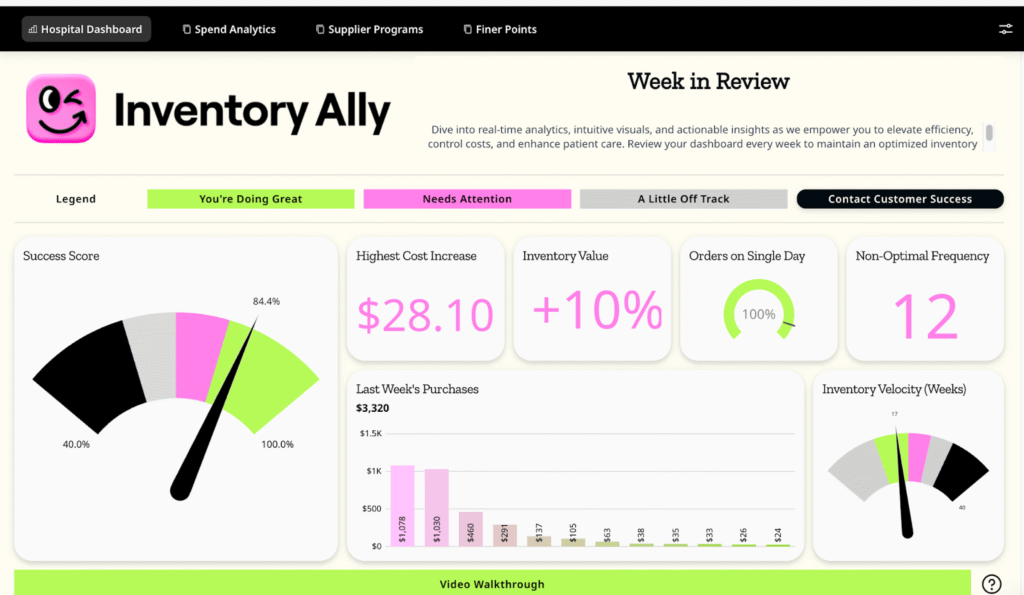
→ Learn how Inventory Ally works or Schedule a free demo
Here’s how it works:
Automated inventory software that tracks usage in real time changes the entire game. Instead of manually counting every item every week, the system monitors what’s actually being used, both products sold to clients and supplies consumed during procedures. It learns your patterns: you go through more heartworm preventatives in spring, flea and tick products spike in summer, and vaccine usage is predictable based on appointment volume.
Smart reorder points prevent stockouts without creating overstock. The system calculates exactly when you’ll run low based on your consumption rate and lead time from suppliers. You’re not guessing anymore, you’re ordering based on data.
Digital count sheets replace clipboards and make cycle counts actually manageable. Instead of counting everything, the system tells you what to count each week based on what matters most: high-value items, fast movers, or products where the system detects discrepancies. A full count that used to take 6 hours now takes 30 minutes.
Vendor integration with one-click ordering eliminates the back-and-forth. Your weekly recommendations show up in a prioritized list: review, adjust if needed, click order.
Forecasting tools reduce overstock and waste. The system predicts what you’ll actually need over the next month based on historical usage and upcoming appointments. No more “better safe than sorry” ordering that leaves you with $100,000 in inventory on hand and a massive tax bill to match.
For context: Todd County Animal Clinic implemented Inventory Ally and within four weeks, their COGS dropped from 43% to 31.9%. With $3 million in annual revenue, that’s $333,000 back to their bottom line, every single year. Their inventory on hand dropped from $100,000 to $77,000, saving another $30,000 annually in Kentucky’s tangible inventory tax. And their team went from needing a full-time inventory position to spending just four hours per week on the entire process.
→ Read more: How Todd County Animal Clinic Saved $363,000 Per Year With Inventory Ally
“Tools like Inventory Ally are interesting when they reduce the cognitive load on the team, especially when they can translate real usage into reorder recommendations and make cycle counts manageable.”
— Adam Wysocki, Founder of VetSoftwareHub.com
Time Waster #4: Disconnected Systems & Repetitive Data Entry

Why it’s killing productivity
Your team is essentially working in silos, and the connective tissue between those silos is… manual data entry. Lab results come back via email, so someone prints them and manually uploads them to the patient record. Payment processing lives in one system, so someone has to reconcile transactions in another. Imaging goes through a separate portal, requiring yet another login and another round of copy-paste.
Every time information needs to move from System A to System B, a human being has to manually bridge that gap. It’s not just inefficient, it’s soul-crushing. Your skilled veterinary technicians are spending so much of their time doing data entry that software should handle automatically.
And when systems don’t talk to each other, information gets lost or inconsistent. Was that heartworm test from last month ever added to the record? Did the client’s new credit card get updated in the payment system? Nobody’s quite sure, so you end up double-checking everything, which creates even more work.
The fix
Integrations between your PIMS, labs, payment processors, and communication tools eliminate the manual handoffs. Lab results flow directly into patient records. Payments sync automatically. Imaging uploads without human intervention. Your team stops being the middleman and starts doing actual medicine.
Automated sync of medical records means information enters your system once and propagates everywhere it needs to go. Update a client’s phone number in one place, and it updates everywhere. No more discovering three months later that half your reminders went to a disconnected number because nobody updated the secondary contact field.
Smart templates handle the repetitive documentation your team does dozens of times per day. Standard procedures, common diagnoses, routine instructions. You can create a template once, then deploy it everywhere. A dental cleaning note that used to take 5 minutes to write now takes 30 seconds to customize, if needed.
The goal is simple: information flows where it needs to go, automatically, without your team acting as human copy-paste machines.
“The best tech stacks are boring in the best way. Data enters once, it propagates automatically, and the team does not have to remember which system is the source of truth.”
— Adam Wysocki, Founder of VetSoftwareHub.com
Time Waster #5: Medical Records That Take Forever

Why documentation becomes a nightmare
It’s 6:30 PM. Your last appointment ended 90 minutes ago, but you’re still at the clinic finishing charts. Sound familiar?
Medical record documentation is non-negotiable: you need accurate, thorough records for continuity of care, legal protection, and practice management. But the way most practices handle it is brutally inefficient: doctors scribble notes during appointments, intending to “clean them up later,” then end up staying late trying to remember details from 8 hours ago.
Or there’s the copy-paste approach: find a similar case from last month, paste the template, modify a few details, hope you caught all the places that need updating. It’s faster, but it creates Frankenstein records full of irrelevant fragments and contradictory information.
Your team is exhausted, documentation backlogs are piling up, and the notes you’re producing aren’t even that good because everyone’s rushing to just get it done.
The fix
AI-assisted medical record tools can dramatically cut documentation time while improving quality. These systems listen during the appointment or process your rough notes afterward, then generate structured SOAP notes in seconds. You review, adjust, approve.
Standardized SOAP templates create consistency across your practice. When everyone uses the same structure for common procedures—wellness exams, dental cleanings, laceration repairs—information is easier to find, quality improves, and new team members get up to speed faster.
Voice dictation lets you document while examining the patient instead of typing later from memory. Modern systems are accurate enough to trust, and they integrate directly with your PIMS. You speak naturally, the system captures it, you’re done.
Clear documentation standards eliminate the ambiguity that causes backlogs. What does “complete” documentation actually mean for your practice? Define it clearly: which fields are required, how much detail is expected, when records must be finished. When everyone knows the target, they hit it more consistently.
The shift here is cultural as much as technological: documentation shouldn’t be something you do after medicine, it should be part of the medicine, happening in real-time, without disrupting patient care.
“The goal is fewer clicks and less rework, not more technology. Any tool you add should remove steps, not add a new place to check.”
— Adam Wysocki, Founder of VetSoftwareHub.com
The Bottom Line
These issues aren’t exotic problems that only affect poorly-run practices. They’re universal challenges that every veterinary clinic faces to some degree. The difference between practices that thrive and practices that barely survive often comes down to which inefficiencies they’ve systematically addressed.
You don’t need to fix everything overnight. Pick one bottleneck, maybe the one that frustrates your team most, and solve it properly. Then move to the next. Small improvements compound into operational transformation.
Your team is already working hard enough. Give them systems that work as hard as they do.
Acknowledgements
We’d like to thank Adam Wysocki for contributing expert insights to this article.
About Adam Wysocki
Adam Wysocki is the founder of VetSoftwareHub.com and a veterinary software consultant who helps practices and vendors evaluate, implement, and improve real world software workflows.